

SpaceX’s upcoming Starship flight, set for Friday, will mark its first attempt to capture the spacecraft at its Texas launch site instead of allowing it to fall into the ocean — a significant test in Elon Musk’s ambition to create a fully reusable rocket system.
The Starship rocket, standing at 124 meters tall, is slated to take off at 5:45 p.m. ET from SpaceX’s Starbase facilities in South Texas. This will be its 15th flight since 2023 and the second mission to deploy a batch of operational Starlink satellites. This mission serves a dual purpose: generating revenue for its satellite connectivity division while also acting as a critical test for a rocket still under development.
As of Friday morning, SpaceX had yet to obtain a launch license from the U.S. Federal Aviation Administration (FAA). Typically, the FAA has granted licenses a day before previous Starship launches, but they have not yet responded to inquiries for comment.
Musk’s space and AI empire considers the next-generation Starship rocket essential for expanding the Starlink network with additional satellites and, in the future, deploying a large array of AI data-processing satellites known as Starmind, as the company increasingly positions itself as a major infrastructure provider.
In September, SpaceX completed its last Starship launch, successfully taking the rocket and its satellites into orbit for the first time, despite some engines shutting down during the flight. That mission, originally planned for a duration of 10 hours, concluded after approximately three hours with a safe splashdown in the Pacific Ocean.
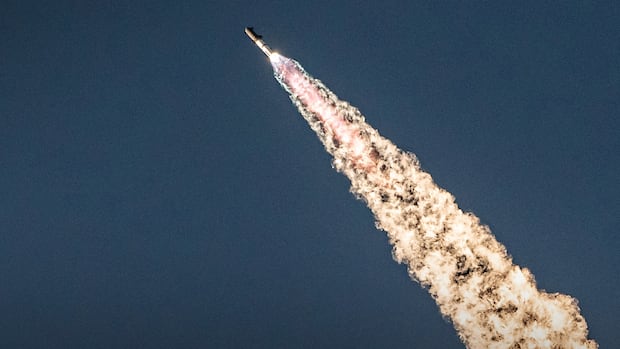
SpaceX astounded engineers, scientists and space enthusiasts by returning its heaviest rocket booster back to its launch pad intact. Beyond the technical marvel of the Starship rocket, reusability is expected to dramatically cut back on mission costs.
For the mission on Friday, SpaceX plans to recover both the Super Heavy booster and the Starship upper stage after launch. The upper stage, which functions as the spacecraft’s top half, is expected to return roughly 22 hours following launch. SpaceX has indicated that this would signify a “breakthrough moment in making Starship a reliable, rapidly reusable rocket” if everything goes according to plan.
Preparing for Starship
The Super Heavy booster, measuring 71 meters tall, has been successfully brought back to the launchpad three times after sending Starship into space, descending vertically into large mechanical arms attached to its launch tower about 10 minutes post-launch. The last such “tower catch” occurred in March 2025.
For this 15th mission, SpaceX must relocate the Super Heavy booster from the launchpad to accommodate Starship, which is anticipated to descend from space after completing 14 orbits around Earth. This paves the way for the inaugural Starship catch to take place around 3:45 p.m. ET on Saturday.
-
Starlink satellites create light pollution and disrupt radio frequencies. And it’s getting worse
-
SpaceX wants to launch a million satellites. Here’s how that could impact the atmosphere and the night sky
Musk anticipates achieving a weekly launch schedule for Starship by the first half of 2027, while SpaceX has mentioned the possibility of starting launches from a new Florida launchpad by the end of 2026.
NASA has contributed approximately $3.2 billion to Starship’s development since selecting the rocket in 2021 to serve as a lunar lander for its astronauts as part of the multibillion-dollar Artemis moon program. SpaceX has invested at least $15 billion of its own capital into the rocket’s development.

Social media video recorded in Turks and Caicos shows debris streaking across the sky after the new Starship rocket broke up during a test flight.
NASA and SpaceX aim for Starship to land astronauts on the moon by 2028, although several significant testing milestones remain, which analysts and industry experts believe may delay that timeline.
These crucial milestones include demonstrating complex fuel transfers between Starship “tanker” rockets in orbit — a vital process that will allow Starship to venture beyond Earth’s orbit to the moon.
Blue Origin, founded by Jeff Bezos, is also working on a lunar lander, Blue Moon, for NASA under the Artemis initiative. Blue Moon is set to join Starship and NASA’s Orion capsule in Earth’s orbit next year for Artemis III, a docking test mission preceding NASA’s planned moon landing missions beginning with Artemis IV.