

Several Albertans who received their mail-in ballots for the upcoming fall referendum expressed surprise and concern regarding a self-declaration requirement featured on the front page of their voting packages. They worry that this stipulation might discourage others from participating in the vote.
Emma Wilkins shared her shock upon opening her special ballot on Wednesday evening, noting that one of the self-declaration requirements — accompanied by a warning — was prominently displayed on the first page.
“I feel really uncertain about what to do next, and it’s disheartening,” the Edmonton resident remarked.
The special ballot package she received indicates that voters must declare their inability to vote in person at a polling station prior to or on election day before completing the mail-in ballots. It also states that providing a false declaration could result in a fine up to $50,000, imprisonment for up to two years, or both.
Elections Alberta clarified that while voters still need to self-declare their Canadian citizenship and age of 18 or older, the wording regarding the inability to vote in person is not applicable to the referendum scheduled for October 19.
However, some voters interviewed by CBC News, who received these packages, remain anxious about what they encountered.
“We are supposed to experience a free and fair electoral process, and this feels quite unfair right now,” Wilkins expressed.
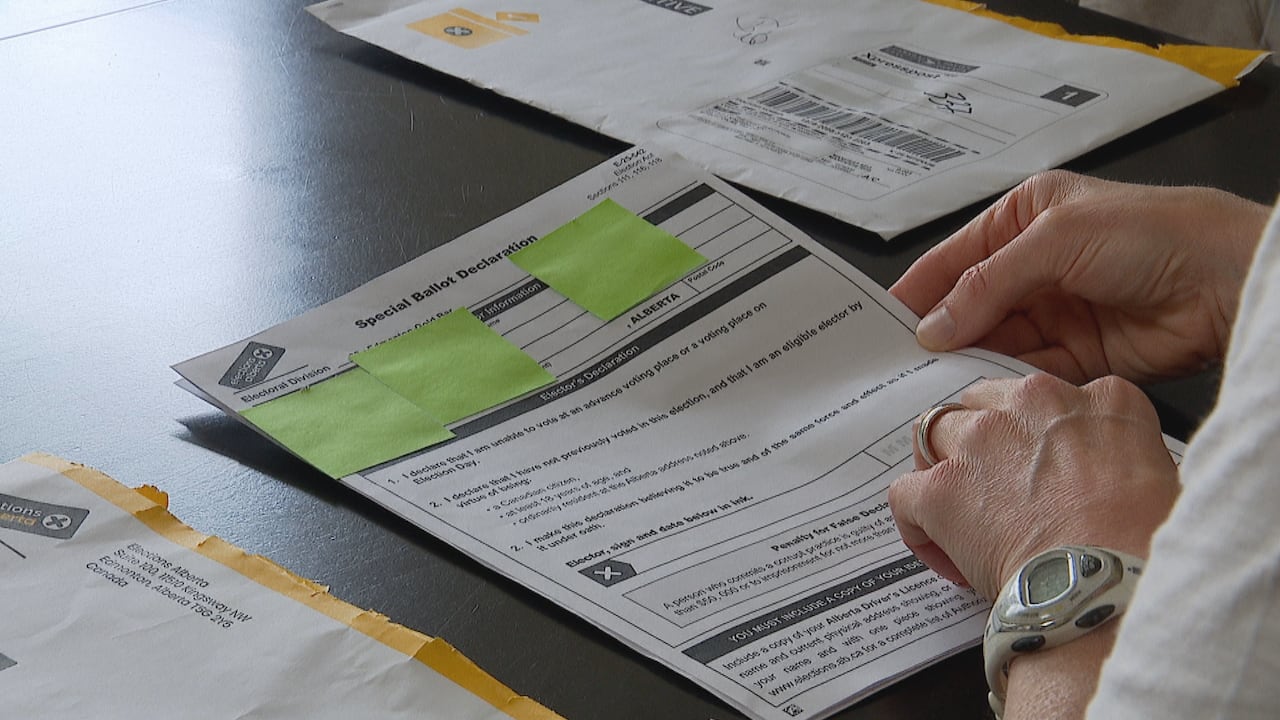
Emma Wilkins reviews her mail-in ballot package, with the self-declaration visible on the first page. (Paul Rampersaud/CBC News)
She noted that she requested a mail-in ballot in July, anticipating potential long wait times at polling stations on referendum day.
In July, Elections Alberta issued a statement regarding special ballot packages, assuring that voters would not need to provide a reason to request a mail-in ballot.

Elections Alberta will begin distributing special ballots today in preparation for the October 19 fall referendum. These ballots allow voters to bypass polling stations and vote by mail on all 10 questions.
On Thursday, Elections Alberta responded to concerns regarding the self-declaration in a news release, explaining that it was “carryover language from an earlier version of the Election Act that mandated reasons for requesting a special ballot.”
The agency stated it will accept mail-in ballots if voters strike through the line that states, “I declare that I am unable to vote at an advance voting place or a voting place on Election Day,” and then complete the remaining part of the declaration.
Wilkins expressed her concern about what this irrelevant self-declaration requirement might imply for voters.
“I can’t believe this was overlooked; it’s such a significant error, especially considering the associated costs,” she remarked.
“Ultimately, taxpayers will bear the consequences. It’s quite surprising to make such a major error in such an important election.”
Lynn Zwicky, another voter from Edmonton, echoed similar worries regarding her special ballot. She mentioned her concerns that the warning about potential penalties might prevent some voters from completing their mail-in ballots.
“I wonder how many people have special ballots like mine and feel uneasy about the declaration,” she stated.
“Will they be intimidated? If they are, they may choose not to vote.”
Zwicky also applied for a special ballot to avoid lengthy lines.
She described the referendum as seemingly complicated, with voters needing to provide answers to all 10 questions on separate ballots. She believes it is essential for Albertans to proactively understand the questions prior to casting their votes.
As of Tuesday, Elections Alberta reported receiving 225,000 requests for mail-in ballots, a figure nearly quadrupling the 59,589 special ballots requested during the 2023 provincial election.
Wilkins warned that complications may arise if voters hesitate to proceed with the self-declaration on the special ballot, leading them to reconsider whether to vote in person.
“I think this adds to the burden of a process that is already causing significant stress,” she commented.
“In the end, it’s the voters who will suffer and may find themselves unable to vote, even if they wish to.”
Elections Alberta has expedited the deadline for applying for special ballots to September 25, moving it up from the original date of October 9.
Gordon McClure, Alberta’s chief electoral officer, stated on Thursday that voters can apply for and return their ballots within the timeframe designated by Elections Alberta.
The referendum, which includes questions on immigration, constitutional matters, and whether Alberta should remain part of Canada or initiate a process for a binding vote on separation, is set for October 19.