
Below are Prime Minister Mark Carney’s remarks to the European Parliament on Thursday:
(In French): Madam President Metsola, Madam President von der Leyen, honorable members of the European Parliament, distinguished colleagues.
Thank you for granting me the honour of addressing you at the start of this decisive session. Today, I will speak to you about how our response to the current geopolitical rupture should integrate a new dimension.
But first, I would like to mention something older. Something that dates back long before relations between the European Union and Canada. Because the depth of our bonds is not measured by trade, nor is it written in our treaties. Our bonds are deeply rooted in our lands.
In the heart of Germany, above Weimar, there is a wooded ridge called Ettersberg. And for decades, Goethe walked, thought and wrote there. An oak on that ridge came to bear his name, a living monument to the highest ideals of European culture. As the 20th century turned dark, that same oak became trapped behind the barbed wire of Buchenwald, a silent witness to humanity’s deepest moral failure.
Goethe understood that ideals must be fought for, that values do not defend themselves. Indeed, at the end of Faust, the old man’s last vision is of a free people on free ground. Nur der verdient sich Freiheit wie das Leben, der täglich sie erobern muß. Freedom and life must be earned every single day.
Every day. Not once in 1945, or 1956, or 1989. Every day, including this one.

Prime Minister Mark Carney delivered remarks about Canada-Europe ties a day after European Commission President Ursula von der Leyen opened the door to Canada becoming an ‘associate’ member of the EU.
Freedom was won through the heroism of the European resistance during the war. It was cultivated by the founders of the European Coal and Steel Community in the aftermath of the war. It was fostered by the creation of the European Community. It was preserved by the establishment of the European Union. And it expanded thanks to its enlargement after the fall of the Berlin Wall.
The values embodied by that Goethe oak have also endured, in part, because the ideals that flourish beneath its branches also crossed the Atlantic.
In 1917, amidst the devastation of the Battle of Vimy Ridge, a young Canadian lieutenant named Leslie Miller gathered a handful of acorns from the shattered European landscape. He carried them home and planted them in Canadian soil near Milliken, Ontario, where they grew into a majestic forest. A century later, a profound circle of renewal was completed. Because grafts from Leslie Miller’s Canadian oaks were repatriated to France and re-planted on the same Vimy Ridge where they had been born.
This is the essence of the Canada-European Union partnership. Seeds, values, ideas, trade, people and progress carried back and forth across the Atlantic for centuries.
We are not fair-weather allies. We do not pursue zero-sum deals. Our commitment to the rule of law, and our unyielding defence of human dignity, individual freedom and democracy share the same deep roots, the same unwavering dedication. We hold common values, for which we have always fought, and in whose defence we must always remain vigilant. We believe that a strong economy is not an end in itself but the means to a just society. We are committed stewards of our natural heritage. We believe that our prosperity grows when it’s shared. These values, this is a sharing of choice not coincidence.
-
Carney says Europe, Canada aren’t ‘fair-weather allies’ while rebuking Trump’s tactics
-
What we know about the proposed partnership between Canada and the EU
In his writings, Goethe borrowed a word from the chemists of his day: wahlverwandtschaften, or the elective affinity of different elements that combine because of their inherent attraction. Canada and Europe are not bound by geography, even though our Danish friends know that we share a 3,000-kilometre border in the Arctic. We are bound by an affinity — elective, chosen and renewed, and stronger for being so.
Today, our societies are shaken by new storms: the upheavals linked to climate change, the erosion of democratic norms and the weaponization of trade. The multilateral institutions we relied on have been weakened.
Sovereignty and openness are now difficult to reconcile. Economic integration is now used as a weapon, and tariffs as a means of leverage. Financial mechanisms are used for coercion. Supply chains constitute points of vulnerability to be exploited. Technology is transforming the nature of war, the structure of economies and the ability of states to govern. Tech platforms aspire to sovereignty. They want to set the conditions of access. They want to dictate regulatory rules, and even bypass them. They want to control our data, spread disinformation and steal our children’s childhoods.
This combination is a ferocious storm. A single tree will come down in it. A forest will not. And that’s because beneath the forest floor, the roots of an oak intertwine with those of its neighbours, exchanging nutrients, adding strength to strength, creating a resilient, self-sustaining ecosystem. Together, Canada and the European Union can anchor our ground to hold our values while forming a protective canopy under which our citizens can thrive.
This is about sovereignty. Our ability to live as we wish. It is about the freedoms we must fight for, every day. Because sovereignty requires resilience — the ability to withstand shocks. Sovereignty today goes beyond being able to feed, fuel and defend ourselves. It now requires secure access to AI, semiconductors, critical minerals, payment systems, clean energy technologies, vaccines and space-based communications. And we all have important gaps in these strategic capabilities, and we each rely on individual nations or individual companies to fill them. And that creates vulnerabilities, particularly when supposedly global companies prove national in the breach.
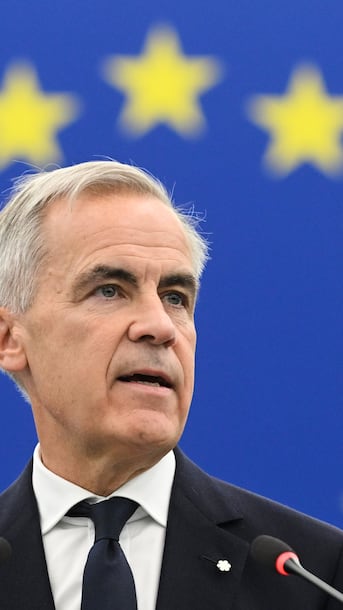
Prime Minister Mark Carney welcomed a call for deeper ties with Europe in an address to the European Parliament, saying a Canada-EU alliance would be a ‘beacon’ for other democracies that is principled, open and ‘strong enough so that no one can dictate our choices.’
Closing these gaps is not possible alone, but it is very achievable collectively. Canada and Europe are each strong. Europe and Canada are stronger together. The institutions we’ve inherited are organized by geography. The strategic capabilities that we need are organized by function. We can ally by function, if we are bold and deliberate. And we shouldn’t be cowed by the perceived scale of the task.
Just as dominance is the arrogance of the hegemon, perfection is the enemy of the good. The economics of this are clear: the leverage of the powerful in an exploitive relationship collapses well before complete independence is achieved. Because diversity confers advantage. The objective is not self-sufficiency. It is collective resilience.
And it’s this mutual advantage that’s at the core of the case for a deeper partnership between Canada and Europe. Europe brings so many things. Market power. Research depth. Advanced manufacturing. The ability and the will to set standards that the world frequently adopts. A defence industrial base that’s being rebuilt at speed.
Canada brings energy at huge scale and in every form that the transition requires. One of the world’s largest endowments of critical minerals. Deep capabilities in space, AI and quantum. Amongst the strongest banking systems in the world, and the most expert pension capital. We have unique Arctic geography, and privileged access to both Atlantic and Pacific networks. And where our strengths differ, they complement. Where they overlap, they create scale. We should build on each other’s strengths – deliberately, systematically, and rapidly.
-
Graphics
Canada and the EU are getting cosy. These charts show how our economies stack up
-
Mark Carney to meet with Emmanuel Macron in Saint-Pierre-et-Miquelon
We’ve already begun, and I thank this Parliament, with CETA, one of the world’s most successful trade agreements. And I thank President von der Leyen and President Costa for our strategic partnership agreement struck last June. We’re developing that and deepening it. We’ve also begun to take advantage of Canada’s role as the first non-European member of SAFE. But we should recognize the ecosystem we’ve built is not yet equal to the ferocity of the changing climate. Nor is it moving fast enough to match the speed of the upheaval.
Yesterday, President von der Leyen spoke of moving beyond CETA to an alliance for the future — opening the door to Canada to become the European Union’s first associate member. Canada welcomes this ambition, and I will tell polling shows that an overwhelming majority of Canadians support much closer ties with Europe. An alliance for the future is a unique, positive approach that we will define together, building on our common strengths and based on shared values.
But let me take this opportunity to say plainly what Canada proposes. Canada and Europe should secure our strategic autonomy through deep co-operation in the full range of strategic capabilities, including critical minerals, defence industrial capacity, AI and compute, energy security, space and payments. We should move towards seamless, digital trade in non-agricultural goods and a wide range of services. We should deepen our people-to-people ties, allowing our youth to live, work and study where they want on either side of the Atlantic.
Canadian membership of Erasmus+ would give your students and ours more opportunity to learn at some of the world’s top universities, to broaden their horizons and to build those lasting ties that will sustain our alliance for the future. Canadian membership of the next generation of Horizon would allow us to pool resources, co-operate on frontier technologies and leverage our world-class research institutes and universities.
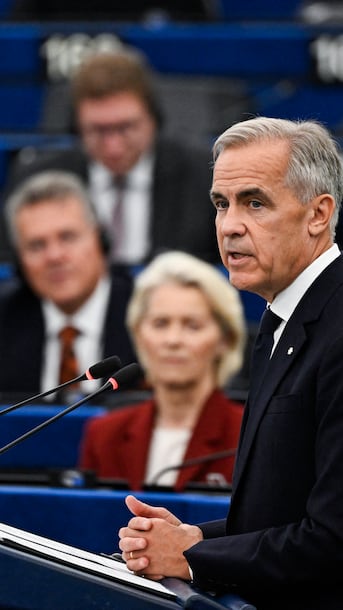
Prime Minister Mark Carney, in an address to the European Parliament, says an alliance between Canada and the European Union would strengthen sovereignty while ‘safeguarding our abilities to live our lives as we choose.’
Yesterday, President von der Leyen announced and I quote, a “new European corporation on critical raw materials” to obtain and stockpile “the material needed for electric cars, chips and batteries, clean tech and defence.” I’ll observe that Canada has deposits of over 34 critical minerals, and we are among the top producers of the 10 most essential for the energy transition.
Our alliance can help fill Europe’s need for reliable supply, Canada’s desire for advanced processing capabilities, and our common objective to complete value chains in the transition and our defence. Canada can contribute LNG and hydrogen at large scale to support Europe’s energy security including by developing and leveraging new port infrastructure in the High North and on our East Coast. And Canada, in turn, can benefit from your leadership in many clean energy technologies.
We can pool new sovereign compute capacity and build more secure broadband connections between Europe and Asia via our common geography. Canada and Europe can join forces to develop AI safety protocols, co-ordinate common standards and strengthen transparency, all while developing applications so our governments and companies can serve out citizens better.
Canada and Europe should consider exploring creating an integrated market for financial services to broaden choice and reduce costs for our citizens, to improve access to capital for our companies while maintaining our world-leading financial resilience.
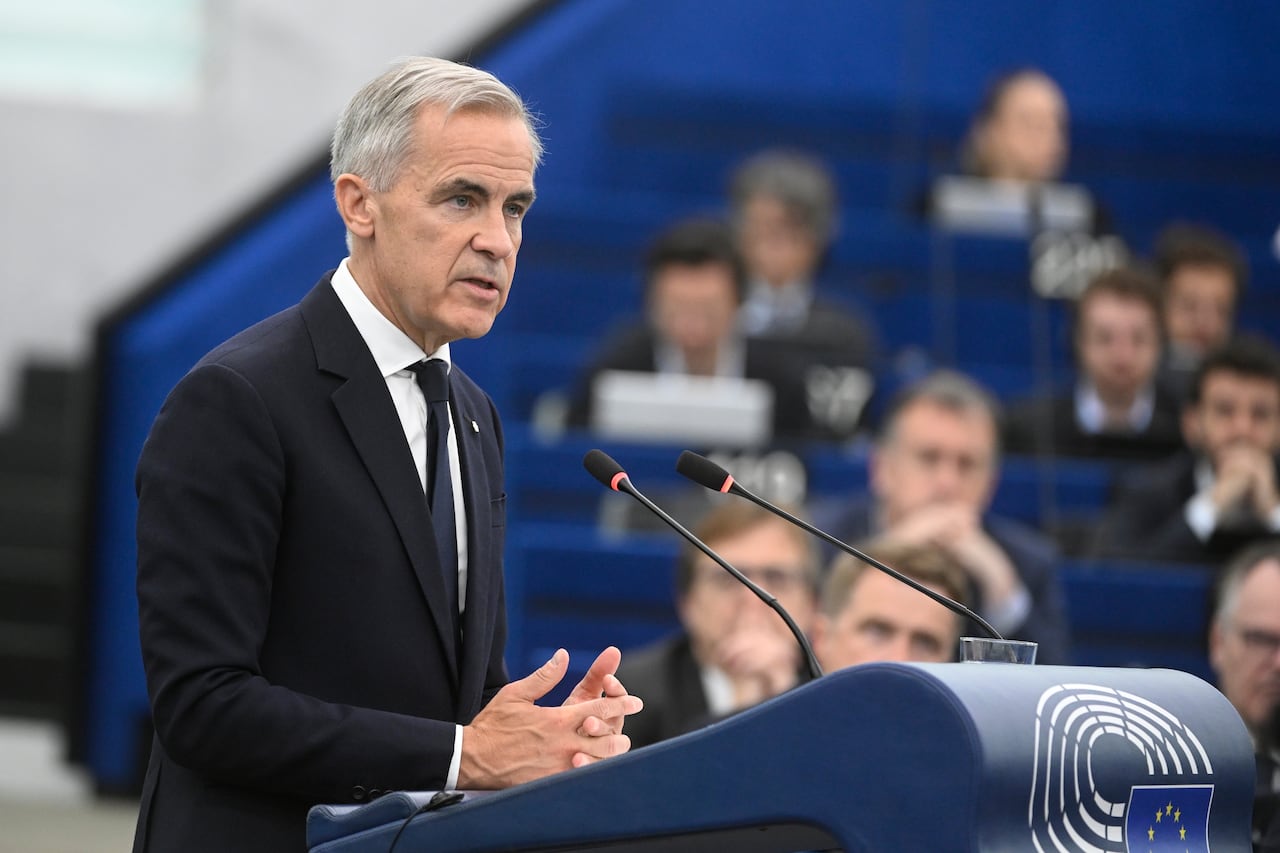
Carney proposed deeper integration with Europe on many fronts, including critical minerals, energy and payments. (Pascal Bastien/The Associated Press)
These are some of the opportunities, but the fundamental point is the opportunities that can be created by an alliance for the future are the product of our values are common, our compatible systems, our complementary strengths. Deepening and widening our relationship will strengthen our sovereignty, improve affordability, opportunity and security for Canadian and European citizens, while safeguarding our ability to live our lives as we choose.
I also want to be precise about what I am not proposing. I am not proposing a third bloc in order to become a great-power rival — only with better manners. We do not seek power to dominate others. On the contrary, we are pursuing resilience so no one, no one can control our open markets, impair our sovereignty, threaten our territorial integrity or undermine our freedoms, our democracies, our rule of law.
It’s these motivations, these fundamental motivations, combined with our latent hard power, mean that we can help to create the next just, stable and prosperous world order. A Canada-EU alliance would create a beacon for other democracies. An alliance not defined by what we oppose, but about what we are for: freedom, solidarity, prosperity, sustainability. An alliance that builds resilience for what it allows us to do for our citizens, and our citizens to do for themselves. An alliance strong enough so that no one can dictate our choices. An alliance open enough that others can join. An alliance principled enough that our strength reinforces international law rather than seeks to replace it.
And to conclude, in my country it’s often said that Canada became a nation during that Battle of Vimy Ridge. And certainly, the thousands of Canadians who didn’t return from that battle sacrificed their lives for something much bigger than themselves. One who did come home stopped first to pick up some acorns. And today, the same Vimy oaks grow in Canada as in France, living proof that what we cultivate together can survive the darkest winter to thrive again.
So let us now deepen those roots, widen this canopy and grow a transatlantic forest under which our citizens can flourish as free people on free ground every single day.
Thank you very much. Merci beaucoup.
Tag: rewrite-pending