

The preliminary endorsement by the U.S. Supreme Court of President Donald Trump’s limitations on mail-in voting has already cast doubt on a voting method that nearly one-third of the nation employs — even if it does not result in any immediate procedural modifications during the upcoming midterm elections in November.
In an unsigned order released on Monday, the court’s majority indicated that it has yet to assess the constitutionality of Trump’s directive, but concluded that the states that filed lawsuits lacked the standing to contest it.
The mere possibility of such a significant modification prompted a dissent from Justice Ketanji Brown Jackson, who cautioned that the ruling “needlessly injects chaos and uncertainty” into the midterm elections.
Trump’s executive order, enacted in March, instructs his administration to compile lists of eligible voters and mandates that the U.S. Postal Service deliver mail ballots exclusively to individuals on those lists.
A separate injunction preventing the Postal Service from implementing changes in response to that directive remains in effect. Nevertheless, late Monday, the administration submitted a motion seeking to lift the second injunction and has introduced new regulations that could be enacted as early as Tuesday if the legal hurdles are fully resolved.
These regulations stipulate specific envelope formatting for mail ballots—which may necessitate a complete overhaul in some jurisdictions—and require states to utilize an electronic system to notify the Postal Service about who is voting by mail. Failure to comply will mean that mail ballots will not be dispatched.
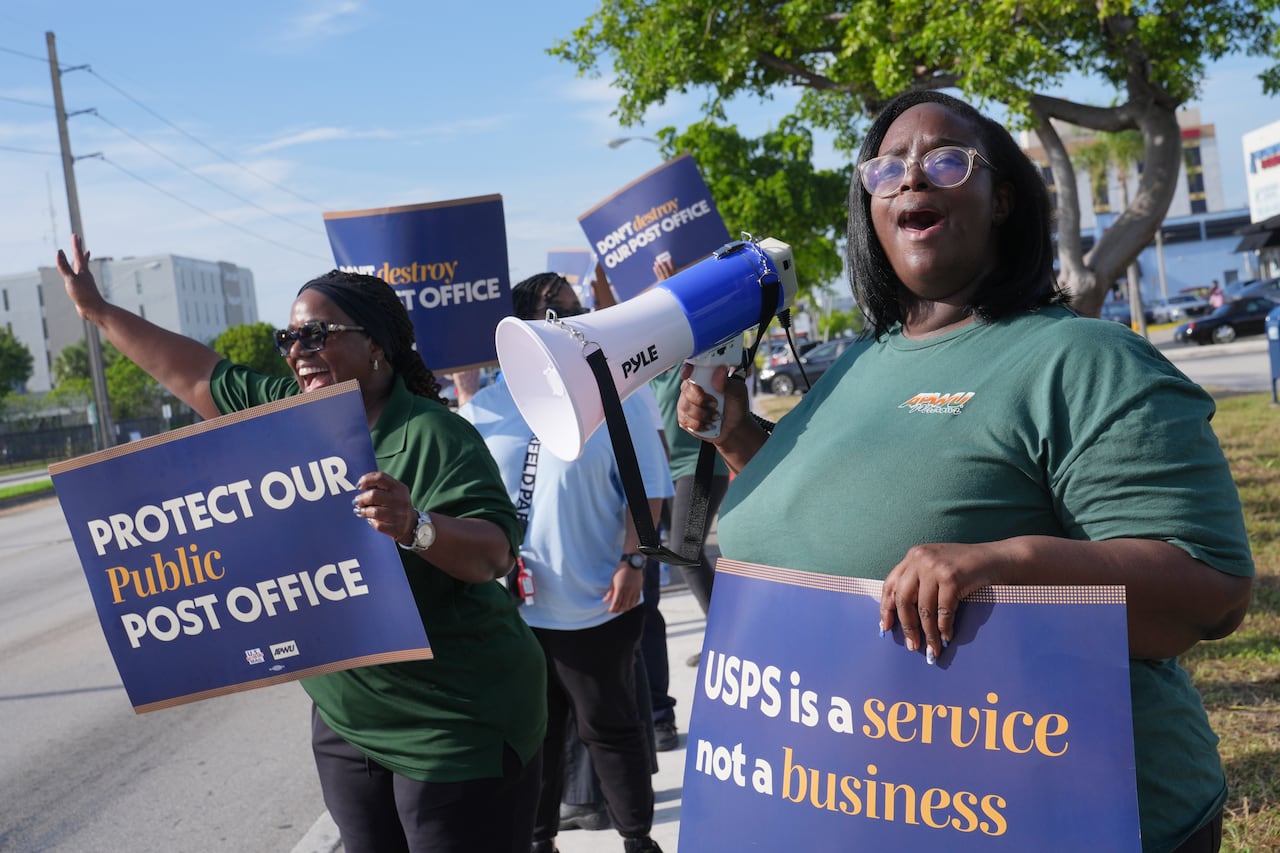
Michelle Curtis, left, and Angela McDonald, right, protest against proposed alterations to the handling of mail-in ballots on July 28 in Miami Gardens, Fla. (Marta Lavandier/The Associated Press)
‘I just don’t see it’
Local officials oversee U.S. elections from countless offices, many of which do not even have a full-time staff member.
Tammy Patrick, the chief program officer at the Elections Center, an organization representing 2,500 election officials, cautioned that adhering to the new regulations would be unfeasible for any state, and noted that none of her contacts have attempted to do so.
“No state conducts its elections [this] way,” Patrick stated in an interview. “There has been an assumption that this will not take place because it cannot be implemented as outlined, since no one operates in this manner.”
Earlier this year, the Trump administration disbanded the Federal Election Assistance Commission, a traditionally bipartisan entity that supports election officials nationwide and has maintained the national mail voter registration form. The commission determined that 29 percent of Americans voted by mail in the 2024 midterms.
Jesse Salinas, the registrar for Yolo County in California and president of the state’s association of election officials, pointed out that ballots in his state will begin to be distributed in 11 days, and his county has already printed its envelopes.
He dismissed the notion of a last-minute alteration in procedures.
“I just don’t see the capacity for that,” Salinas remarked.
Ongoing White House initiatives
Judges previously prevented Trump from enacting new voting restrictions through executive order last year. This year, a legislative effort to overhaul voting procedures, known as the Save America Act, stalled in the Senate, with Republicans informing the White House that it likely fell short of the 60 votes necessary for passage, even after Trump delivered a prime-time address underscoring its significance.
Earlier this year, Trump’s administration faced a setback when the Supreme Court ruled 5-4 that states are permitted to count ballots that arrive after election day.
This ruling followed a few weeks after Trump made false claims regarding elections in California, where the lead shifted in several races as additional ballots were counted hours and even days after polls closed.
Additionally, the administration has encountered legal challenges in its attempts to obtain voter roll data from various states, with federal judges rejecting multiple requests. Election officials have stated that these efforts violate both federal and state privacy regulations.
Trump has succeeded in two of the three presidential elections that featured the highest proportions of mail-in or absentee ballots, yet he has consistently criticized the practice, asserting it is prone to potential fraud. Consequently, Democrats are now more inclined to use mail voting compared to Republicans, marking a partisan divide that was less pronounced prior to Trump’s emergence in national politics.
While voter fraud does occur, it typically manifests on an individual level. There is no evidence to substantiate claims of widespread or systematic fraud to support Trump’s assertions that millions of unauthorized U.S. residents voted for his Democratic opponent in the 2016 election, nor that his defeat four years later to Joe Biden was orchestrated.

Tag: rewrite-pending