

On Thursday, U.S. envoys engaged in discussions with Russian President Vladimir Putin at the Kremlin before traveling to Ireland for a meeting with Ukrainian President Volodymyr Zelenskyy, as Washington aimed to revitalize its peace initiatives.
Envoys Steve Witkoff and Jared Kushner, who is also the son-in-law of U.S. President Donald Trump, facilitated discussions this week between delegations from Moscow and Kyiv. The talks, held in Abu Dhabi, United Arab Emirates, marked the first direct dialogue between Ukrainian and Russian officials in nine months due to a halt in the settlement process.
While the talks did not yield significant advancements, they resulted in an agreement for a substantial prisoner exchange, with the specific number yet to be disclosed. Additionally, plans for a subsequent round of talks were revealed, with Witkoff and Zelenskyy indicating that European participation would be included, though they did not specify which nations or the number of representatives.
Kushner and Witkoff spent approximately two hours with Putin before proceeding to Dublin, Ireland, where they met with Zelenskyy for over an hour as the conflict approaches its fifth year.
Kushner mentioned that one objective of the meeting with Putin was to obtain the Russian leader’s approval for European representatives to join the discussions, which are considering the broader security framework for the continent.
During the Abu Dhabi meeting, several European security advisers were present on the sidelines, although they did not participate in the main three-way discussions.
Before departing Moscow, Witkoff informed reporters that the next round of talks has been confirmed. Russian state television displayed Witkoff stating that “the Europeans will join at the next meeting,” although he did not provide further details.
In Dublin, Zelenskyy suggested that European representatives would not be mere observers. “At the next meeting, Europe will be part of the negotiations, as a negotiating team — not in some separate capacity. They will have a voice,” he stated.
The U.S. and Zelenskyy are advocating for Europe to designate a single representative to negotiate with Moscow.
Conversely, Russia is opposed to European nations participating in direct negotiations, arguing that they are funding and arming Ukraine’s military activities. European leaders are apprehensive about Russia’s actions and its broader intentions in the region.
However, Washington and European governments have sometimes appeared misaligned in their diplomatic strategies. Trump has frequently supported Putin, having recently lifted sanctions and finalized a deal for importing Russian diesel, moves that have troubled Ukrainian and European officials.
Kremlin spokesperson Dmitry Peskov asserted that for Europe to participate in peace negotiations, it must first appoint a representative.
“The Europeans argue among themselves like spiders in a jar. If anyone attempts to reach out to the Russian side, they face ostracism,” he remarked.

Putin again warns against European troops
Many in Europe view the inclusion of Moscow in discussions about postwar European security as an unwelcome concession to Putin, who has labeled NATO’s expansion toward the east as a primary security threat and has demanded the withdrawal of the alliance’s troops from Russia’s borders.
Some analysts believe that negotiators may be considering offering Russia concessions regarding NATO’s strategy as a trade for peace in Ukraine — a prospect that alarms European leaders.
Putin’s aide, Yuri Ushakov, described Thursday’s discussions as “substantive, constructive, frank, and useful.”
He added that the Kremlin leader reminded Witkoff and Kushner of Moscow’s proposals from 2021 — prior to the troop deployment into Ukraine — which called for NATO to reverse its military presence in Central and Eastern Europe. Russia intends to update these proposals with “fresh considerations,” Ushakov noted.
Putin reiterated to the U.S. envoys that any deployment of European soldiers to Ukraine after a ceasefire — a concept often proposed by Europe to avert a new attack from Moscow — would be “absolutely unacceptable,” viewing such a move as a security threat and legitimate targets.
“In other words, the war would resume immediately,” he stated.
He also mentioned that Russia considers its border with Ukraine to be defined by a future peace agreement, extending to encompass the four Ukrainian regions that Moscow annexed in 2022 but has not fully controlled.
Zelenskyy is in Dublin for a summit involving over 40 European nations, which also features NATO Secretary General Mark Rutte. Canadian Prime Minister Mark Carney was also in attendance.
Rutte stated that the U.S., Europe, and Ukraine are “very much aligned” regarding the desired security guarantees, following a meeting in Paris in January.
“However, we now need a peace agreement, or at least a ceasefire,” Rutte added.
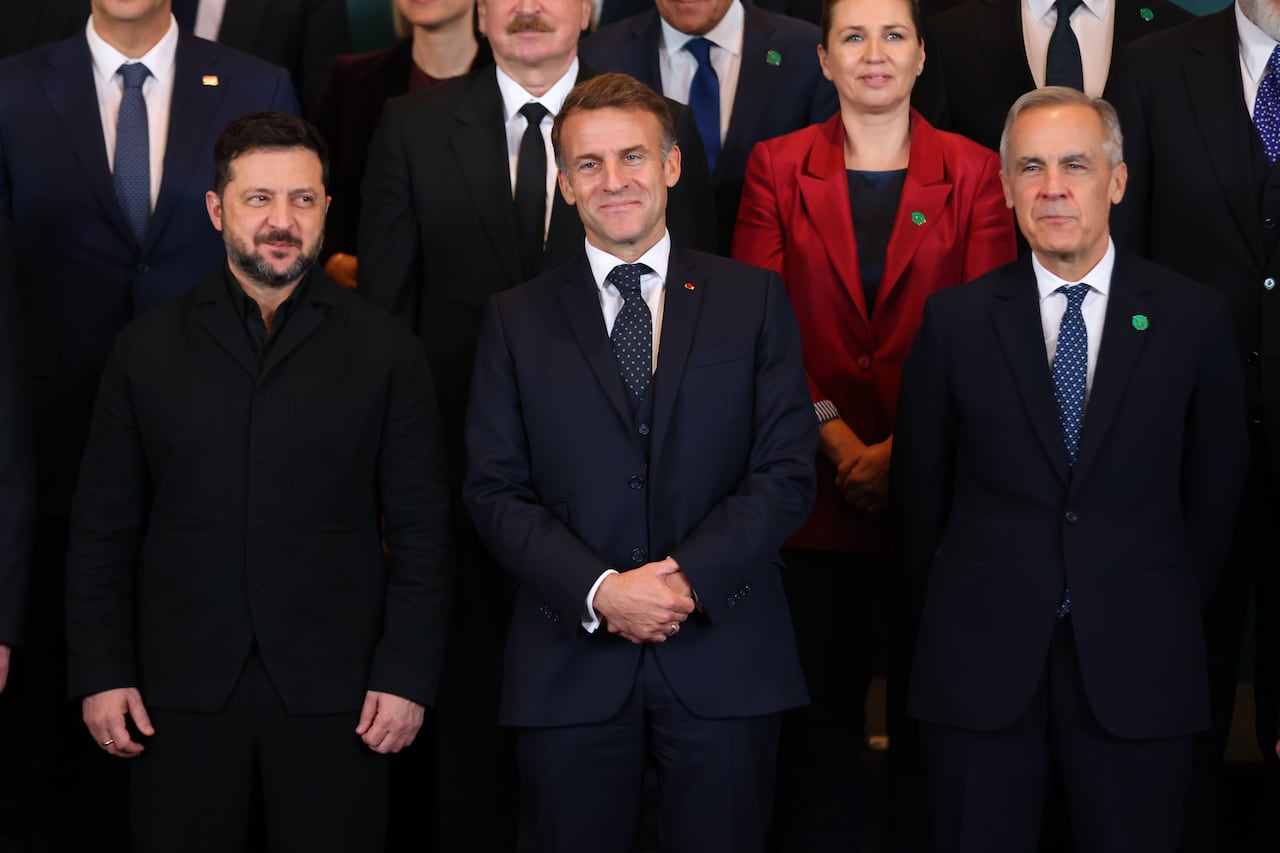
Ukraine’s President Volodymyr Zelenskyy stands next to French President Emmanuel Macron, centre, and Canadian Prime Minister Mark Carney as they pose for a photo along with other leaders at the European Political Community (EPC) Summit in Dublin, Ireland, on Thursday. (Peter Morrison/The Associated Press)
While negotiations are underway, fighting persists along the 1,200-kilometer front line.
Ukraine’s determined resistance has prevented Russia’s larger army from advancing, while Moscow’s drone and missile assaults aim to deprive civilians of heat, electricity, and water, undermining public morale in what Kyiv describes as a “weaponization of winter.”
According to Russia’s Defence Ministry, its air defenses intercepted 71 Ukrainian drones overnight. The ministry stated that Russian forces targeted a drone-manufacturing facility in Kyiv and three additional sites producing missile fuel and drone components around the Ukrainian capital.
The Ukrainian air force reported that Russia launched a total of missiles and 123 drones, including 73 jet-powered drones, targeting various locations in Ukraine overnight, with 17 strikes confirmed.
Zelenskyy says Starshield service disrupted again
Ukraine is facing another slowdown in the U.S. Starshield system — SpaceX’s military-grade variant of the Starlink satellite internet service — crucial for the country’s defense against Russian assaults, according to Zelenskyy’s social media update on Thursday.
Military units have reported “significant disruptions,” including speed limitations that have restricted their drones to a maximum of 161 km/h, Zelenskyy indicated, adding that a military inquiry determined that these restrictions were not random glitches.
Ukraine relies on Starlink and Starshield for intercepting Russian drones and conducting its own strikes.
Last month, restrictions on the speed of Ukrainian drones severely hampered their operations, raising concerns among Kyiv officials about a potential decrease in U.S. support.
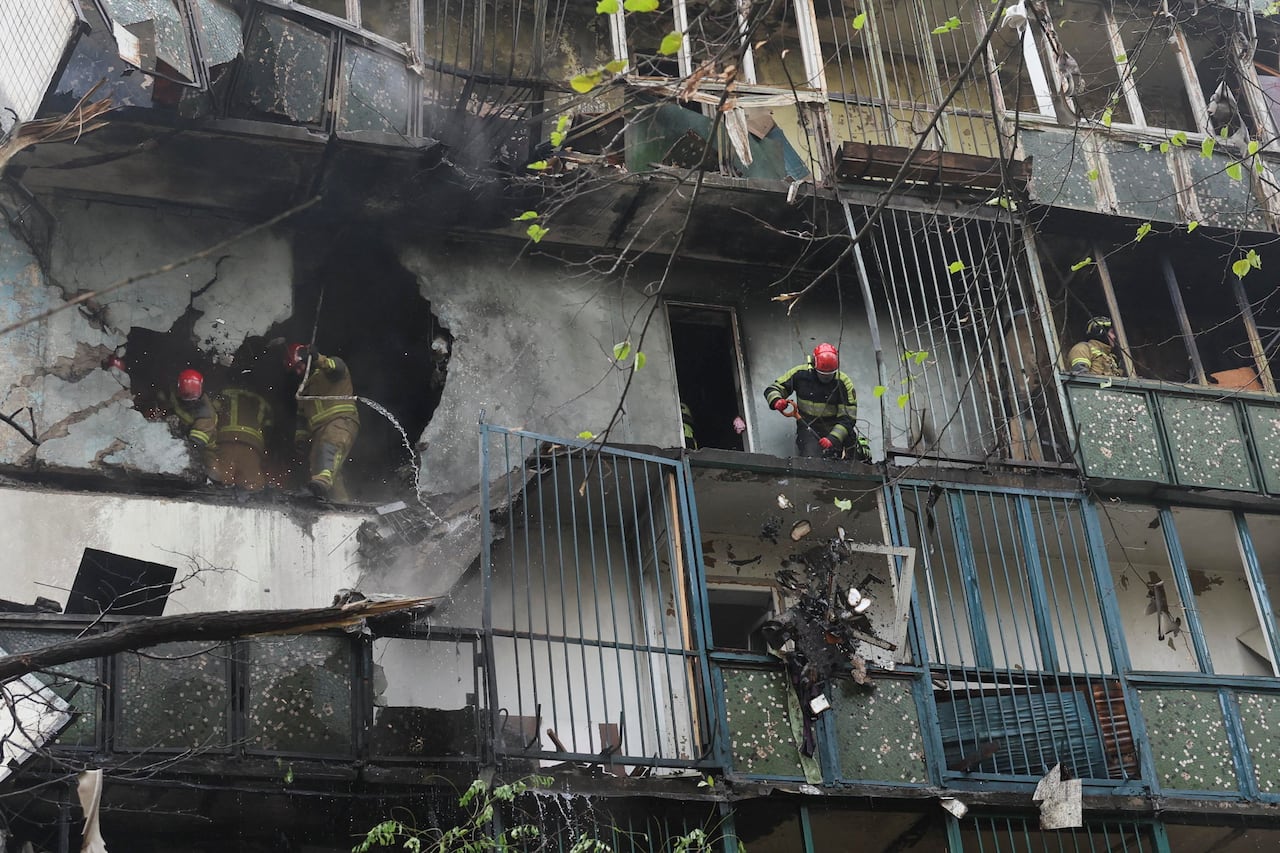
Firefighters work on Thursday at an apartment building in Kyiv that was damaged following a Russian drone strike. (Gleb Garanich/Reuters)
SpaceX CEO Elon Musk acknowledged that his company had limited the Starlink internet service in Ukraine for about a week, citing that the system was not intended for offensive operations against Russia.
Zelenskyy stated that the speed limitations affect operations in areas of Ukraine occupied by Russia, and Kyiv is seeking clarification from U.S. officials regarding the situation.
Republican House member reacts to reports of Starshield throttling:
A Russian serviceman died in St. Petersburg early Thursday when his vehicle exploded, as reported by the Investigative Committee, the country’s main criminal investigation agency. The victim’s identity has not been disclosed, and the perpetrators of the bombing remain unknown.
Fontanka news outlet reported that the deceased was a colonel, and a bomb detonated in his car as he was driving.
Several high-ranking Russian military personnel have been killed in bombings and other attacks that Moscow attributes to Ukraine. Kyiv has taken responsibility for some strikes on Russian territory.