

Calgary’s condominium market is experiencing a significant shift.
After years of price hikes, many sellers are now slashing their asking prices by tens of thousands to entice potential buyers.
With additional housing developments on the horizon, the downward pressure on prices may persist.
“There is an excess of inventory. Currently, demand is low,” noted realtor Sukh Pangly.
At a new project in the northeast area of Cornerstone, he mentioned that prices have plummeted by as much as $85,000 for condos that have remained unsold for months.
Buyers are taking notice.
“We started with around 100 units last month, and following our price reductions, we now have about 30 remaining,” Pangly said.
A two-bedroom, two-bathroom unit that was initially listed in the low three-hundred-thousands is now available for $230,900.
Similarly, a one-bedroom, one-bathroom condo in the same building saw a price drop of $55,000, bringing it down to $194,900.
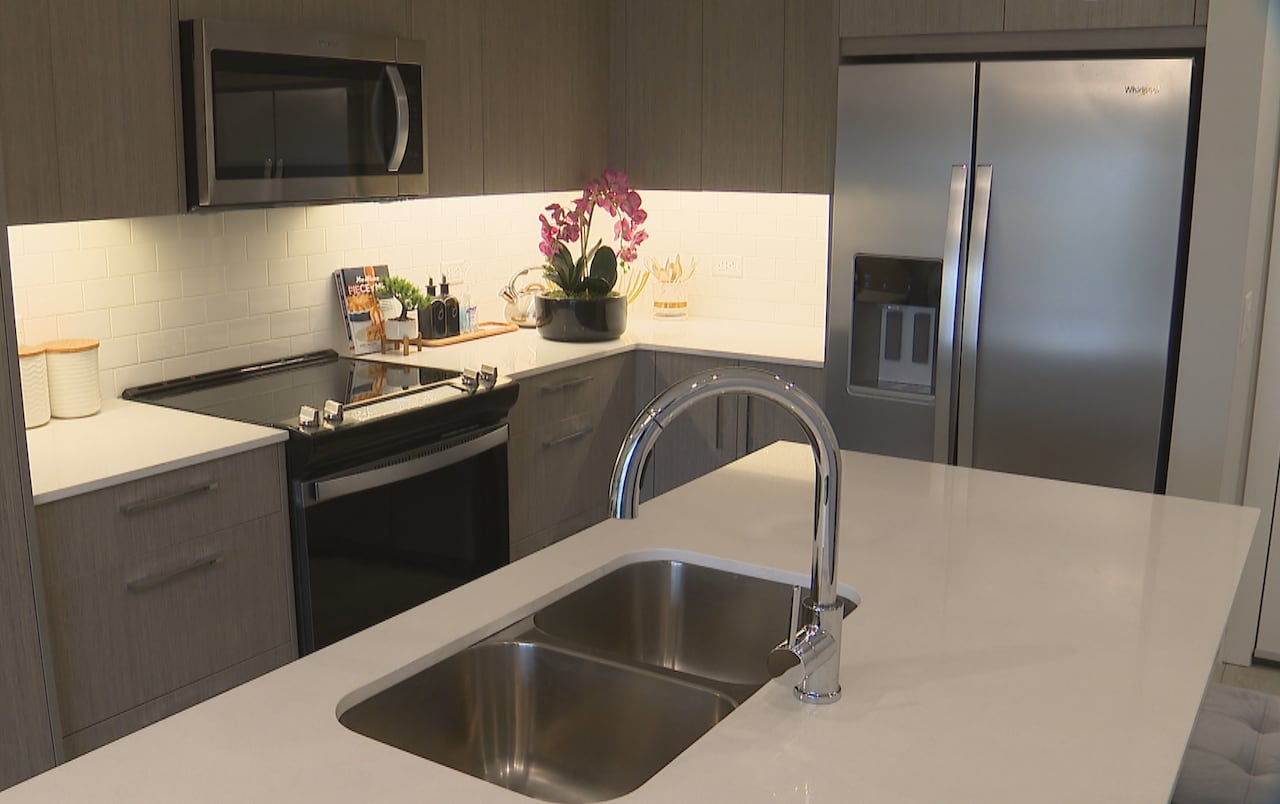
The price of this new two-bedroom, two-bathroom condo in northeast Calgary has dropped $85,000 to $230,900. (Ryan McLeod/CBC)
Pangly describes the price drop as more of a correction, stating that these reductions highlight the increasing competition among sellers.
This is a notable shift for a city that, until recently, faced challenges in keeping up with housing demands due to its rapidly increasing population.
According to the Calgary Real Estate Board (CREB), Calgary’s benchmark condo price fell to $288,000 in October, marking an eight percent decline from the previous year and a 15 percent drop from its peak in August 2024.

Realtor Sukh Pangly indicates that Calgary’s condo market is oversaturated. He mentions that with an influx of supply and a decrease in demand, some builders are lowering prices by as much as $85,000 to attract buyers. (Ina Sidhu/CBC)
The Path to Calgary’s Current Situation
For many years, Calgary was a magnet for newcomers due to its comparatively affordable housing and job prospects, which led to a boom in home construction.
However, with a slowdown in population growth, the city now faces a new set of challenges.
“The number of newcomers to the city has significantly decreased compared to a few years back, while we were constructing homes based on a higher migration rate,” explained Ann-Marie Lurie, chief economist at CREB.
Lurie added that the deceleration is not solely due to fewer people relocating to Calgary. An increase in rental availability is providing alternatives to purchasing homes, and interest in investment acquisitions has also waned.
“There is a wider selection available, which is granting buyers more leverage in negotiations,” Lurie stated.
Continued Housing Developments Ahead
Calgary’s construction boom is far from over.
In 2025, home construction reached unprecedented levels in Calgary.
Purpose-built rental construction represented the bulk of this increase. According to CREB, over 17,000 apartment-style units are currently being built, with around 70 percent designated as purpose-built rentals.
Although these rental units will not directly increase the condo supply, Lurie pointed out that they will still influence the market dynamics.
She indicated that supply pressures could persist into the following year, leaving the future of prices uncertain.
Lurie also noted that this slowdown does not equally impact all types of housing.
The markets for detached and semi-detached homes remain relatively stable, with prices holding steady, according to CREB.
Overall, sales in October saw an 11 percent decline compared to the previous year.