

On Tuesday, the White House released a statement detailing “facts” about Canada’s long-term exploitation of its trade relations with the United States.
This was yet another escalation in the ongoing trade conflict between the two nations. Negotiations regarding tariffs collapsed on Friday night when Prime Minister Mark Carney withdrew, citing that the U.S. “demanded too much while offering too little.”
Some assertions made by the White House concerning Canada are accurate, while others reflect opinions that U.S. President Donald Trump has consistently held or are claims subject to interpretation. Below is an analysis of the White House’s statements.
-
Federal ministers announce support for Canadians, counter-tariffs against U.S.
-
Q&A
Canada ‘can’t afford’ to wait for Trump to be reasonable, says jobs minister
Are we alone with China in retaliating against U.S. tariffs?
The initial assertion in the White House’s statement claims: “Canada stands alongside the People’s Republic of China in choosing retaliation rather than negotiation.”
While Canada has engaged in negotiations with the U.S. for the past month, this assertion seems accurate. Several trading partners have threatened to retaliate against Trump’s tariffs but have not yet followed through.
- With the trade conflict intensifying, are you considering buying Canadian products again? We want to hear your thoughts — email us at ask@cbc.ca.
Mexico is currently in talks to reduce similar tariffs affecting Canada on steel, aluminum, and vehicles, though it has not issued specific threats of counteractions.
Brazil has announced potential actions in response to U.S. tariffs. Both the U.K. and the European Union contemplated counter-tariffs following “Liberation Day” in 2025 but chose to defer any action.
Canada imposes tariffs on vehicles imported from the U.S.
The statement accuses Canada of implementing “discriminatory” tariffs of 25 percent on vehicles imported from the U.S., labeling this move as unjust, claiming the tariffs were “not applied to any other country.”
This is factually correct; however, the rationale behind Canada imposing the tariff on April 9, 2025, was in response to the U.S. having enacted similar tariffs just days before. The tariff specifically targets non-CUSMA-compliant vehicles imported from the U.S., mirroring the U.S. action against Canada.
The negotiations that broke down on Friday were partly centered on the possibility of eliminating or at least reducing that tariff.
Has Canada banned most U.S. alcohol from shelves?
One of the most notable actions taken by Canadian provinces following the new tariffs imposed by Trump in 2025 was the removal of U.S. alcohol from the shelves of state-run liquor stores.
The White House statement asserts: “Canada has banned American wine, beer, and spirits across nearly all provinces and territories — unlike other countries which have faced no such restrictions. Consequently, U.S. alcohol exports to Canada plummeted by 81% in just one year.”

Bottles of Canadian liquor are displayed at a B.C. Liquor store in Vancouver on Tuesday. (Ben Nelms/CBC)
It is accurate that all provinces, except Saskatchewan and Alberta, have implemented this ban. Premiers have recently stated that they would only lift the bans if there is a significant reduction or elimination of Trump’s tariffs. Following the collapse of trade discussions, they maintain that U.S. alcohol will not be returning to the shelves in the near future.
In recent months, politicians from California have urged Canada to lift the ban, arguing that it has negatively impacted wineries in their state. Last week, Kentucky Governor Andy Beshear acknowledged that the bourbon industry is suffering, as Canada is the top trading partner for his state.
Does Canada impose a 300% tariff on U.S. dairy?
Trump has consistently criticized Canada’s dairy sector, and the White House reiterated this point.
“Canada restricts U.S. dairy imports with tariff-rate quotas that are significantly more stringent than those applied to Europe, along with over-quota tariffs approaching 300% — rates so severe that they effectively act as a near-total ban and rank among the highest agricultural tariffs globally,” the statement contended.
However, Canada hasn’t completely locked out U.S. dairy. The regulations are intricate, but U.S. dairy producers can export to Canada without tariffs, within a specified limit — which they have never surpassed. If they exceed that limit, tariffs can reach 250 percent, but this situation has not occurred.
What particularly frustrates the U.S. is that its retailers cannot sell dairy directly in Canada, which is why American milk is unavailable in grocery stores.
Conversely, Canada’s agreement with the EU permits certain retail brands from there to sell their products in Canada, especially cheese, which the U.S. argues is inequitable.
It’s important to note that the existing tariff regulations on U.S. dairy entering Canada were negotiated and agreed upon during Trump’s first term.
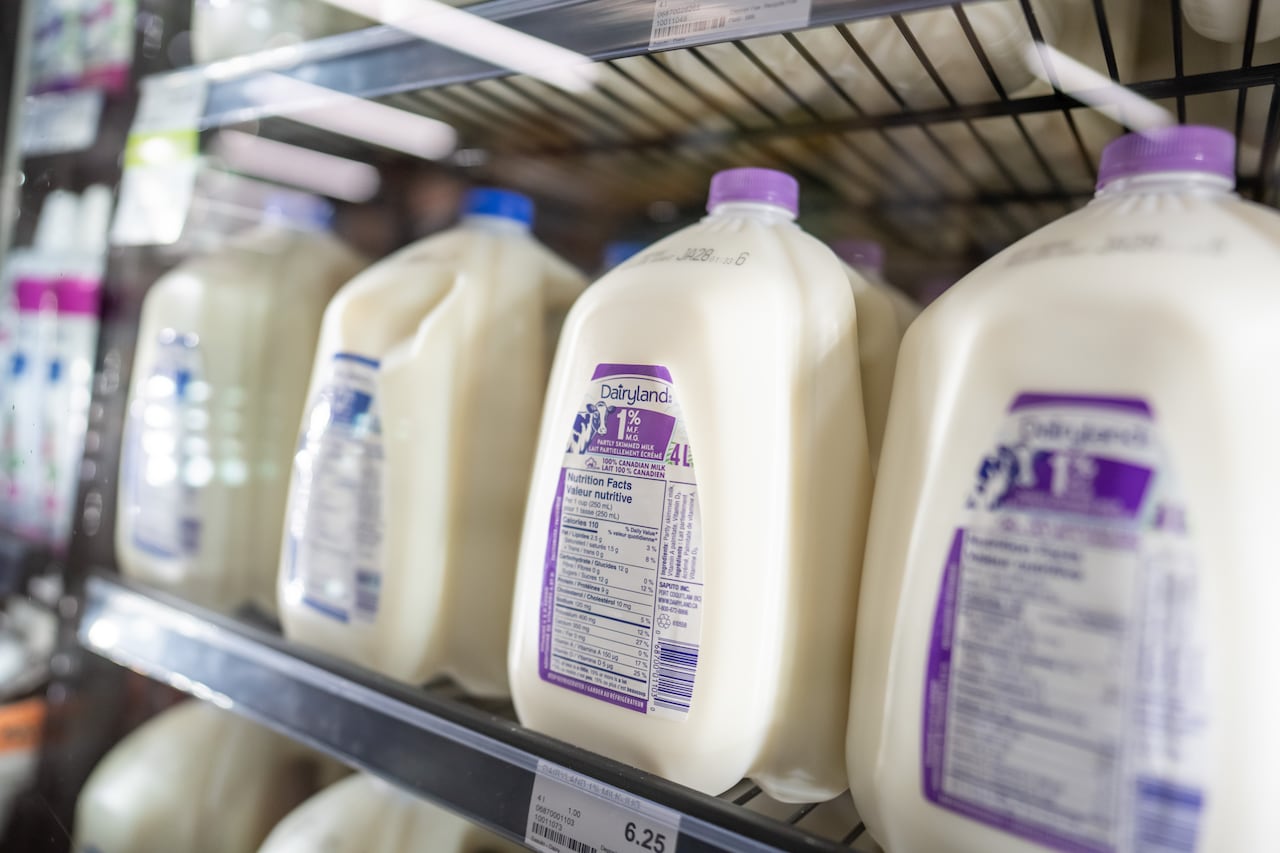
American retailers are prohibited from selling dairy directly in Canada, which is why U.S. milk is unavailable in grocery stores. (Ben Nelms/CBC)
The U.S. trade deficit with Canada
Trump frequently focuses on trade deficits, viewing them as indicative of weakness.
According to the White House, “Canada has maintained a persistent average annual goods trade deficit of about $50 billion with the U.S. over the last decade, while denying reciprocal access.”
The overall figure is accurate (it was $48.5 billion in 2025, according to the U.S. Trade Representative). However, as premiers and others have consistently pointed out, the primary reason for this is that Canada exported 3.9 million barrels of oil daily to the U.S. last year.
States along the Canadian border require this oil, which is sold at below-market prices, providing a significant economic advantage to the U.S.
If this oil were excluded from the analysis, the U.S. would have a goods surplus with Canada. In essence, when excluding energy, the U.S. exports more goods to Canada than Canada exports to the U.S.

Finance Minister François-Philippe Champagne states that Canada will respond to the latest U.S. tariffs in a ‘proportionate, targeted and strategic’ manner. Champagne emphasized that the tariffs, affecting more than $27 billion in U.S. goods, are ‘all about fairness.’
Some White House claims can’t be fact-checked
The statement encompasses a series of “facts” that are largely opinions or contentions that are debatable.
For instance, it claims: “Without the United States, Canada could not exist. Canada exports approximately three-quarters of its goods to America.” While this statistic is accurate, and Canadian officials acknowledge the significance of the U.S. market, the notion of Canada’s survival without the U.S. is a speculation that is not being seriously considered.
“The statement also posits: “Canada’s ineffective trade policies are forcing its manufacturers to relocate south. A recent survey indicated that 42% of Canadian manufacturers have either moved or plan to move production to the U.S.”
The KPMG survey indicates that companies are relocating or planning to relocate “due to economic uncertainty and trade and tariff threats,” rather than due to “Canada’s ineffective trade policies.”
The White House’s statement concludes by asserting that the U.S. “holds the clear advantage” due to its significantly larger economy. While no one questions the scale advantage, the discussion over who holds the upper hand in this trade conflict remains unresolved.
- Do you support Canada’s new retaliatory tariffs on the U.S., scheduled for September 8? Click “Join the Conversation” below. On the app? Tap here.
Tag: rewrite-pending