

On Monday, Prime Minister Mark Carney stated that Canada stands ready to engage in negotiations whenever the U.S. approaches with the “right attitude.”
However, Jobs and Families Minister Patty Hajdu emphasized that Canada cannot afford to be patient.
The federal government has allocated $7.5 billion to assist workers and employers in navigating the challenges posed by the trade conflict. The new initiatives feature improved access to Employment Insurance for impacted workers, along with various loan options for businesses.
Hajdu explained that these measures will provide Canadian entrepreneurs with the necessary time to adapt to the evolving economic landscape and reduce their dependency on the U.S., as both nations implement 50 percent tariffs on each other’s products.
In an interview with As It Happens guest host Paul Hunter, Hajdu discussed these issues. Here is an excerpt from their dialogue.
Minister, many Canadians are experiencing significant anxiety at the moment. Do you believe these new initiatives will alleviate their concerns?
I believe these new programs send a powerful message to small- and medium-sized businesses, which will be primarily affected by the latest tariffs, that we are there to support them.
And it’s not just the employers but also their employees who are essential to the success of these businesses.
This initiative aims to not only assist with business liquidity but also to help companies retain their skilled workers and ultimately provide support for those who may lose their jobs in a worst-case scenario.

Industry Minister Mélanie Joly announced $7.5 billion in support to help workers and businesses weather the 50 percent U.S. tariffs being imposed on $27.6 billion of Canadian goods. The package comes on top of the nearly $25 billion in tariff support implemented over the past 18 months, the federal government said in a statement.
Are you implying … to Canadians that they should prepare for job losses?
What I am communicating to Canadians is that we are not delaying in our efforts to assist those who may lose their jobs.
Overall, the Canadian economy remains robust, with various sectors showing significant activity. Nonetheless, these tariffs will have a disproportionate effect on specific industries and businesses.
Some businesses will successfully adapt, and some have already started this transition. Many others are actively exploring new products, markets, and partners.
However, smaller businesses that heavily depend on the U.S. may struggle. If a business cannot remain operational, we want to ensure those workers are adequately supported, not just through Employment Insurance, but also by providing access to training and opportunities to secure new jobs in different sectors.
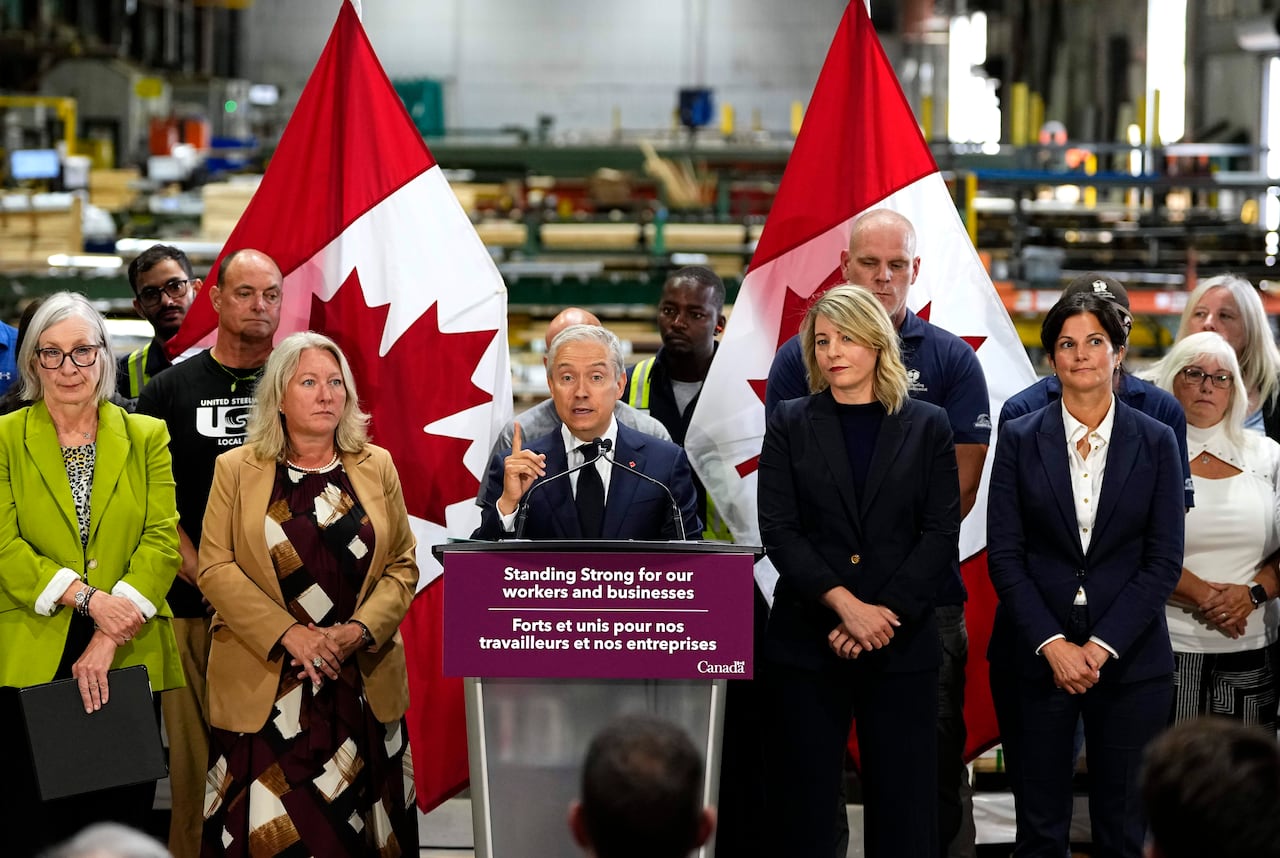
Minister of Finance and National Revenue François-Philippe Champagne speaks at a news conference on Canada’s response to U.S. tariffs, at a roofing company in Ottawa on Tuesday. (Justin Tang/The Canadian Press)
A recent study by the University of Calgary estimates that Canada could lose up to 87,000 jobs due to the latest U.S. tariffs. Do you foresee these figures? And if so, can Canada manage to provide the necessary support on such a scale?
I believe Canada cannot afford to wait. As the Prime Minister and our Minister of Finance have both indicated, we are in a strong fiscal position to support both employers and employees, ensuring we have the resources needed to navigate this challenging period.
Apart from the assistance, your government has also introduced retaliatory tariffs on a variety of U.S. imports. However, just as Americans ultimately bear the cost of Donald Trump’s tariffs on Canadian goods, Canadians will also face increased costs if they choose or need to purchase these items. How should people anticipate this impacting their living expenses?
No one desires to impose tariffs, nor should anyone, as you correctly noted, they raise costs and reduce choices for Canadians. We approach this reluctantly, but we are resolute in our commitment to stand by Canadian companies and employers.
Ultimately, we must encourage Canadians to prioritize purchasing domestic products. In fact, we are responding to what Canadians expect us to do, as they have been supporting one another since the onset of this tariff conflict, consciously opting for Canadian products, vacations, and manufacturers whenever possible. We view this as a necessary step to safeguard our Canadian employers.
Conservative Party leader Pierre Poillievre has been urging Prime Minister Carney to disclose the details of what your government decided against on Friday night. Given the sacrifices Canadians may ultimately have to make, should they be granted more transparency regarding what was discussed last week?
I believe the terms of the proposed agreement and the evolving nature of these discussions have been quite publicly shared. In fact, they have been more transparent than many trade agreements I have seen during my 11 years in politics. Hence, that level of transparency has been evident.
We have collaborated with stakeholders, industry representatives, labor partners, and politicians from various parties on advisory committees. This has been a collective effort to negotiate with the United States.
Conservative MP Shuvaloy Majumdar argues that Canadians are being asked to make significant sacrifices in the trade war with the United States, and they deserve to understand the reasons behind it. Majumdar, who serves as the Conservative shadow minister for U.S.-Canadian relations, spoke with As It Happens guest host Paul Hunter.
The Prime Minister mentioned yesterday that Canada is ready to re-enter negotiations when the U.S. approaches with the “right attitude.” Today, the U.S. President was suggesting renaming Lake Ontario “Lake America.” This indicates that his attitude may not be changing anytime soon. Realistically, how long do you expect Canadians to endure this new situation?
I think the key question is how swiftly the Canadian economy adapts to selling to alternative markets. We have no control over the actions of the U.S. President. However, we can manage the support we extend to employers and encourage them to take steps toward finding new markets, products, and business methods. The federal government is committed to facilitating that process.
However, finding new markets is not an overnight process.
That is true, but I can assure you that numerous companies across Canada are diligently exploring not only new international markets but also collaborating with the Canadian government on initiatives that incorporate Canadian products into significant projects in defense and infrastructure.
There are opportunities available throughout the country, and this forms part of our economic strategy to strengthen our domestic economy by leveraging Canadian businesses and products.
Tag: rewrite-pending