
Prime Minister Mark Carney is working towards establishing a “distinctive partnership” with the European Union, while Canada’s ambassador has dismissed the idea of contributing directly to the budget of the 27-nation union.
In a recent interview with CBC’s The House airing on Saturday morning, Jonathan Wilkinson, Canada’s new ambassador to the EU, stated, “We will be very selective. This isn’t a blanket approach. It does not equate to membership in the European Union.”
Wilkinson acknowledged that some programs might necessitate funding, citing the EU’s Security Action for Europe (SAFE) initiative, which provides loans to member countries for defense-related investments.
Currently, Canada is the sole non-European nation participating in this program. He also mentioned potential collaborative efforts in areas such as enhancing Canada’s critical minerals sales through European investments or partnering with the EU on artificial intelligence and other digital technologies.
Wilkinson elaborated, “There are specific areas identified by the prime minister as strategic capabilities — those where nations need access to certain resources to make independent decisions.” He is set to take on his new responsibilities in the coming weeks.
During his address to the European Parliament on Thursday, Carney formally expressed his intention to strengthen ties between Canada and the EU, revealing some aspects of his vision, including:
- “Seamless, digital” commerce in non-agricultural goods and services.
- Canadian participation in Erasmus+, the EU initiative supporting education, training, youth, and sports in Europe, which encompasses cross-border student exchanges.
- Canadian involvement in the next phase of Horizon, the EU’s research and innovation funding initiative, of which Canada has partial access until the current program concludes in 2027.
- Collaboration on computing power, broadband infrastructure, and AI safety measures.
- Exploring a unified financial services market.
However, it remains uncertain if Canada will need to concede anything in exchange or whether EU member states and the Canadian Parliament will endorse the agreement. Carney has committed to facilitating a parliamentary vote and discussion regarding the proposed alliance with the EU.
Wilkinson expressed that he would approach key issues raised by some opposition parties, such as potential amendments to migration policies, with “extreme caution.”
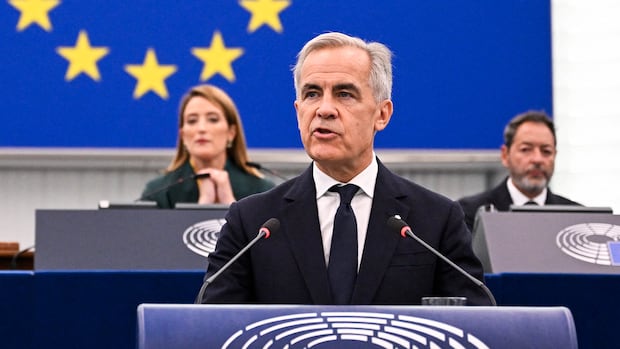
A day after Canada was given the opportunity to become an ‘associate member’ of the EU, Prime Minister Mark Carney addressed the European Parliament, promising enhanced connections with Europe, although ambiguities remain regarding the specifics.
“Are we discussing mass movement across the two regions? No, and the notion that this is somehow tied to the irregular migration issues in Europe… The borders in Canada are fundamentally different from those in Europe,” Wilkinson remarked.
“Canada will maintain its complete sovereignty.”
Reactions from European Politicians
Thomas Byrne, Ireland’s minister of state for European affairs and defense, shared with The House that both parties share numerous commonalities, such as a dedication to democracy, free trade, and the rule of law.
“We recognize that the U.S.A. is no longer as committed to the type of tariff-free trade that we once saw. Thus, we need to forge other connections,” Byrne noted. “This creates a level of shared objectives between us.”
- Cross Country Checkup is inquiring: Is Canada more aligned with Europe than the United States? What implications do you see if Canada strengthens its bonds with the EU? Share your thoughts here and we may feature your input or reach out for Sunday’s show
Byrne emphasized that the current focus appears to be on mutual advantages for both parties rather than imposing requirements on one another.
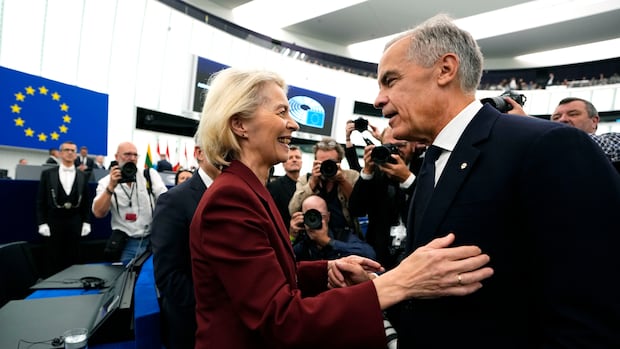
Prime Minister Mark Carney spoke to the European Parliament on Thursday, asserting that an alliance between Canada and Europe would ‘protect our ability to live freely.’ Roland Paris, former foreign policy advisor to Justin Trudeau, and Arash Saeidi, an MEP, reflect on what such an alliance might entail.
“We are equal partners across the Atlantic,” Byrne remarked.
In contrast, Arash Saeidi, a European Parliament member from France, expressed his concerns regarding the proposal, stating, “If we engage in discussions about this, we might waste our time, resulting in a decade of inaction.”
Saeidi urged that the emphasis should be on strengthening relationships in diplomacy, culture, and academic research instead of debating a formal arrangement.
The Impact of Trump
A significant obstacle to Carney’s initiative is U.S. President Donald Trump, who dismissed the idea of closer Canada-EU relations as “laughable” and threatened to impose new tariffs if it was viewed as “a hostile act.”
Fen Osler Hampson, co-chair of the Expert Group on Canada-U.S. Relations, remarked, “It is reasonable to assert that Europe will act in its own best interests.”
“Many Europeans are already advocating for increased strategic independence from the U.S. for the same reasons that we are,” he added.
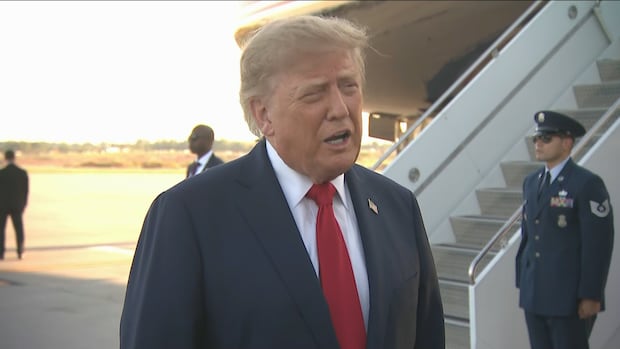
U.S. President Donald Trump warned the European Union of “very serious tariffs” or the potential to “halt trade” if a trade agreement with Canada is made “with bad intentions.”
Hampson pointed out that Trump should not forget that both Europe and Canada are substantial investors in American equity markets, and Canada holds a significant portion of U.S. debt.
“Thus, when he speaks about restricting trade… if he follows through on those threats, he is harming his own interests,” he remarked.
When asked if Trump’s threats could deter the EU from reaching an agreement with Canada, Wilkinson replied, “I think it’s up to the Europeans,” but expressed skepticism that this would happen.
-
FRONT BURNER
Is a shaky U.S. bond market good for Canada?
-
Far-right German politician heckles Carney with ‘U.S.A.’ chant before EU address
Carney emphasized in his speech that Canada is not “establishing a third bloc to become a global power — merely with better conduct.”
“We do not seek dominance over others. Rather, we aim for resilience to ensure that no entity can control our open markets, undermine our sovereignty, threaten our territorial integrity, or erode our freedoms, democracies, or rule of law.”
Tag: rewrite-pending