
Iran has committed to resisting the enhanced U.S. sanctions designed to isolate its economy, asserting that it believes key trading partners will withstand Washington’s coercive strategies.
As the U.S. faces a protracted conflict that has proven difficult to resolve, Treasury Secretary Scott Bessent announced the new measures on Monday, although they did not include the most severe sanctions.
For decades, Iran has endured multiple layers of U.S. and international sanctions that have severely impacted its economy without deterring its leaders.
In response to any economic actions by the U.S., Iran threatened possible military retaliation and a further reduction in oil exports from the Gulf. Following the announcement, Iranian Economy Minister Ali Madanizadeh stated that Iran is ready for the challenges ahead.
“Our defense strategy has evolved; our adversaries should prepare for an offensive,” he remarked during a broadcast on state television. He also pointed out that neither China nor Russia has “accepted” the U.S. sanctions, predicting that additional nations would resist them as well.
-
Trump administration expands U.S. sanctions on Iran targeting countries with business ties to Tehran
Brig.-Gen. Hossein Mohebbi, spokesperson for Iran’s Islamic Revolutionary Guard Corps, warned of significant strikes against U.S. critical interests and energy chokepoints if Iran’s infrastructure comes under threat, according to Press TV.
Bessent’s announcement came as Iran’s rial reached an unprecedented low. The currency had already been facing challenges prior to the war, with Iran grappling with double-digit inflation and negative economic growth.
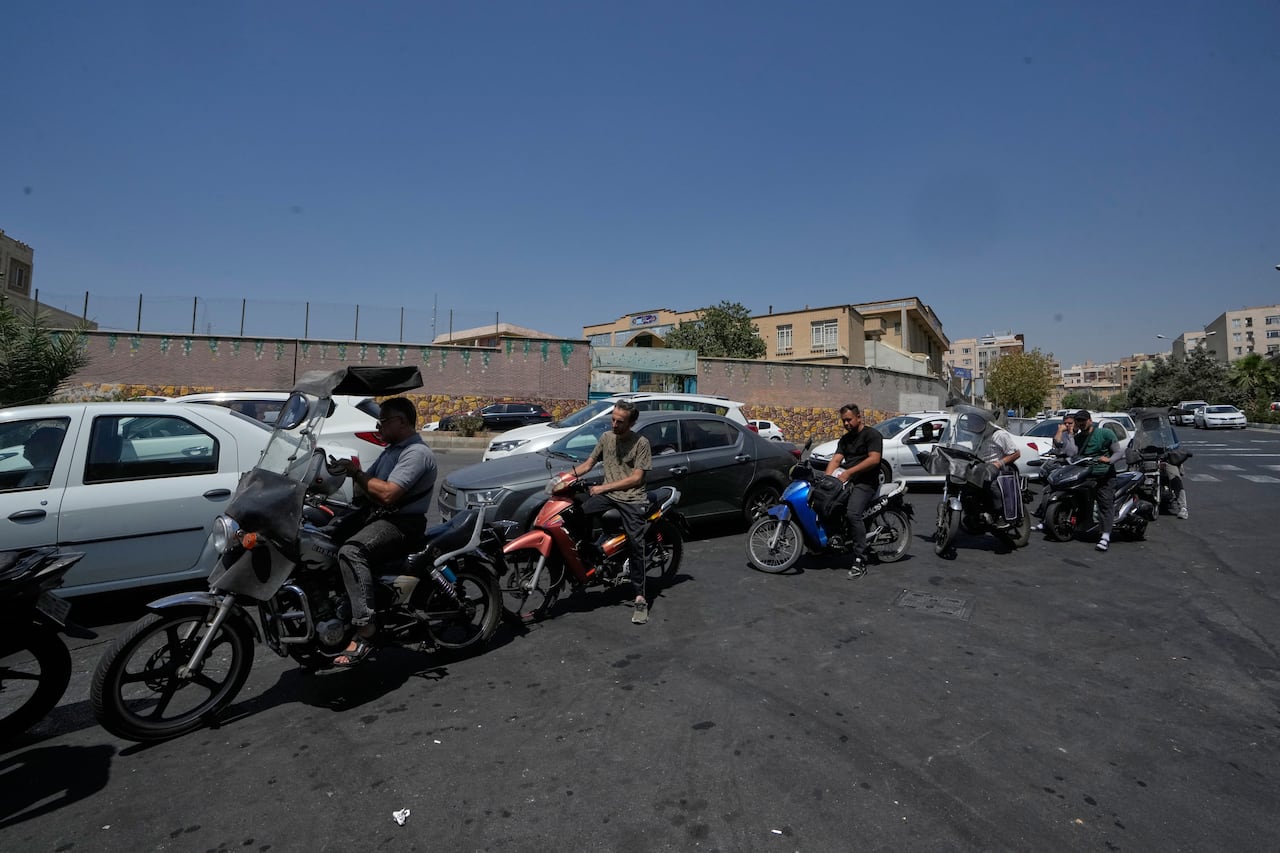
Motorcyclists and drivers line up outside a gas station in Tehran, Iran’s capital, on Tuesday. (Vahid Salemi/The Associated Press)
Daily essentials are becoming increasingly expensive for Iranians. Since the onset of the war, rice prices have surged by approximately 60 percent, while beef costs have risen by over 150 percent. The International Monetary Fund projects that the country’s gross domestic product will shrink by more than five percent.
Before the announcement, Trump took to social media to declare, “IRAN IS COMPLETELY COLLAPSING!!!”
This statement contrasts sharply with his remarks in January when demonstrators across Iran protested against corruption and economic hardship. At that time, Trump had said that “help is on its way,” and six weeks later, amid the outbreak of war, he assured Iranians that the government “will be yours to take” once the U.S. completed its military operations.
China maintains it’s abiding by international law
In June, Iran and the United States reached an interim agreement aimed at resolving the war that commenced with U.S. and Israeli assaults on Iran on February 28. However, this deal quickly fell apart, leading Iran to resume its attacks that have hampered most energy exports from the Gulf.
Bessent indicated that nations engaging in trade with Iran risk being excluded from the dollar-based financial system, though he did not provide a timeline or specify which countries might be impacted, stating he would allow them time to adapt to the new rules.
“Why would I want to destabilize the global financial system?” he responded when asked why the sanctions had not escalated further.
The Treasury Department did announce fresh sanctions affecting 60 individuals, entities, and vessels, yet the list notably excluded any Chinese financial institutions believed to be aiding Iran’s oil trade.
“We want to emphasize today that no one is beyond the reach of U.S. sanctions,” Bessent stated in reply to inquiries regarding Chinese banks.
Five months on, America and Iran can’t even agree on whether they are negotiating or not. The Economist’s Gregg Carlstrom brings us the latest on the effort to reopen the Strait of Hormuz. Iran expert Ali Vaez says President Donald Trump is stuck between an unwinnable war and an unpalatable peace.
For several years, China has been the largest purchaser of Iranian oil, although the U.S. blockade of Iran’s ports has reduced oil shipments to China since Washington reinstated the measures in mid-July.
Analysts suggest that Washington is cautious about provoking Chinese retaliation regarding any sanctions on its banks, especially with anticipated discussions next month between President Donald Trump and Chinese President Xi Jinping, as any restrictions on China’s exports of essential minerals could be particularly sensitive.
On Tuesday, China asserted that its cooperation with Iran operates within the bounds of international law and should not face interference or disruption.
No indication of a resolution in the Hormuz crisis
Oil prices experienced a second consecutive day of decline as traders dismissed the effects of the sanctions, although market players remained cautious about Iran’s persistent capacity to disrupt shipping operations.
An oil tanker was hit by an unidentified projectile on Tuesday, becoming disabled approximately nine nautical miles (17 km) northeast of Oman’s Ash Shishah, located at the entrance to the Strait of Hormuz, as reported by the United Kingdom Maritime Trade Operations.
Oil transit through the Strait of Hormuz was recorded at five million barrels per day on Monday, according to preliminary tracking from shiptracker Vortexa, a significant drop from over 20 million barrels per day prior to the war, representing about one in every five barrels consumed globally.
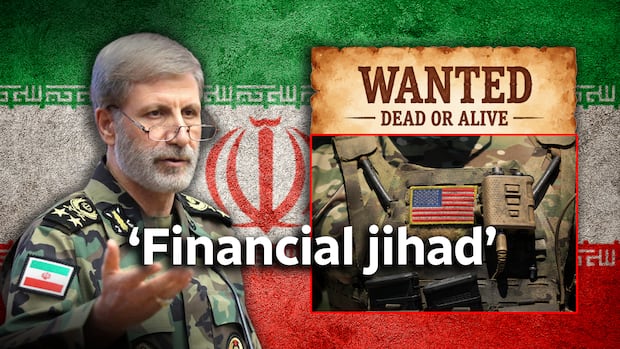
Iran is offering a $30,000 US bounty to any Iranian who can capture or kill American soldiers. Andrew Chang breaks down why the timing of the announcement matters, its propaganda value, and how realistic it actually is.
(Photo credits: The Canadian Press, Reuters, Adobe Stock and Getty Images)
Despite a lack of significant strikes from either side in recent weeks, there is scant evidence of a diplomatic resolution in sight.
Iran continues to pose threats to its Gulf neighbors and oil tankers. The status of its nuclear program, which the U.S. and Israel aim to dismantle, remains unclear.
-
Trump threatens to bomb Oman if it ‘gets in the way’ with Iran
-
U.S. signals it can keep up naval blockade indefinitely, increase economic pressure on Iran
Pakistan, acting as a mediator, reported “significant progress” in recent discussions with Tehran that aimed at preventing further escalation and reopening the Strait of Hormuz, according to the Pakistani military.
“We had a very constructive exchange,” noted Pakistani Interior Minister Mohsin Naqvi, who was present with army chief Asim Munir during the Tehran visit, on X.
An official from the Iranian president’s office, Mehdi Tabatabaei, stated on X that Munir’s visit to Iran “yielded highly valuable diplomatic achievements, the results of which will soon be disclosed.”
The conflict has claimed thousands of lives, primarily in Iran and Lebanon, while much of Iran’s conventional military capabilities have been diminished, its economy is faltering, and the then-supreme leader Ayatollah Ali Khamenei was killed. His son, Mojtaba, has been appointed as his successor but has not appeared publicly since reportedly being injured in U.S. and Israeli airstrikes.